Something Old, Something New: The Traditions, Explained
The rhyme, the veil, the bouquet, the ring finger and the cake — where the best-known wedding customs came from, and what they were meant to do.
Much of what happens at a Western wedding is done because it has always been done. Most of it has a story behind it, and some of those stories are rather better than the customs themselves. Here are the origins of the ones you are most likely to meet — and, where the history is uncertain, we say so.
The rhyme
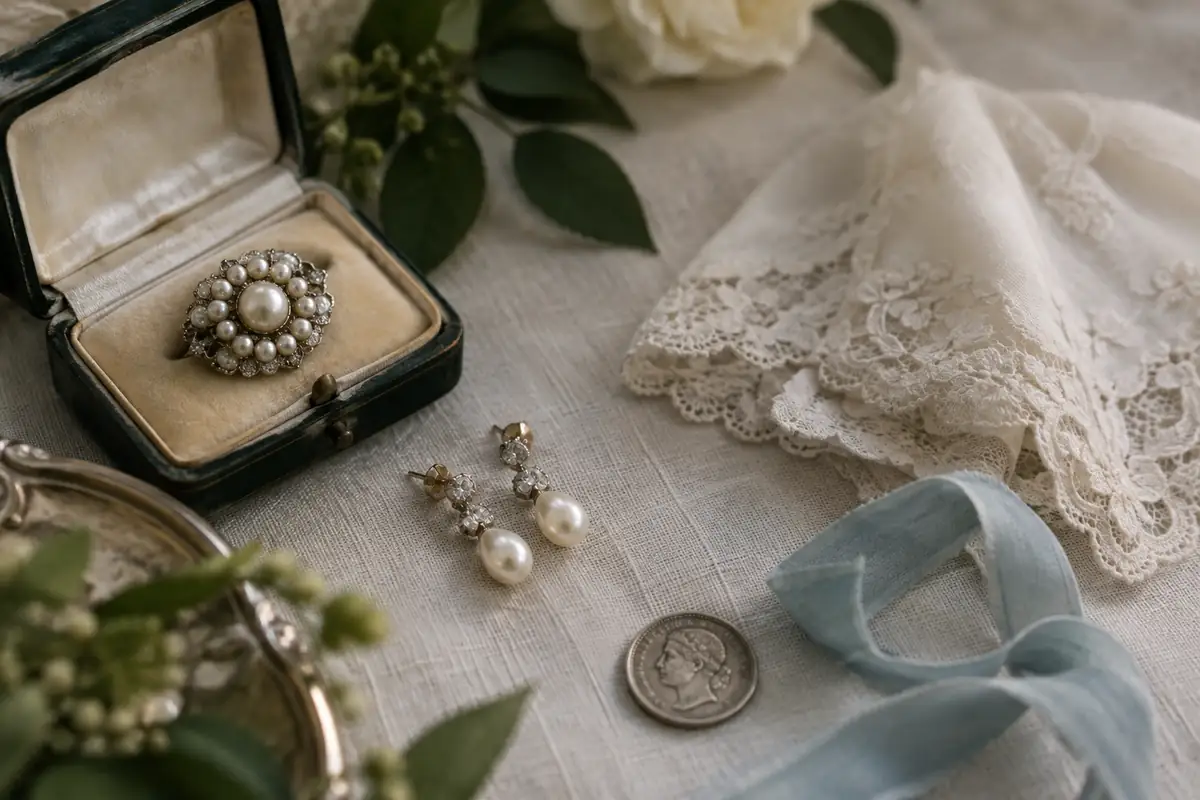
Something old, something new,
Something borrowed, something blue,
And a silver sixpence in her shoe.
The rhyme is English and Victorian; it was first recorded in print in 1871, already described as a folk custom. Each item was a token of good fortune.
Something old stood for continuity — the bride’s family and the life she came from. An heirloom, a mother’s or grandmother’s piece of jewelry, a scrap of lace from an older dress sewn into the new one.
Something new looked forward to the marriage itself. Most often it is the dress, but it can be anything.
Something borrowed was lent by a happily married woman, in the hope that her good fortune would pass to the bride. It must be returned — that is part of the luck.
Something blue was for faithfulness and purity; blue had long been associated with the Virgin Mary, and the bride traditionally wore a blue ribbon. Today it is usually hidden: a garter, the lining of a shoe, an embroidered initial inside the hem.
A silver sixpence in her shoe is the forgotten fifth line, a wish for prosperity. British sixpences have not been minted since the 1960s, but you can still buy one, and some families have passed the same coin from bride to bride for generations. It goes in the left shoe.
The white dress
White was not traditional until surprisingly recently. For most of history brides wore their best dress, whatever its color. Queen Victoria’s white satin gown in 1840 made white fashionable among those who could afford a dress worn only once — which was the point: white was difficult to clean and expensive to keep, and it signaled wealth as much as purity. It became the norm for most brides only in the twentieth century.
The veil
The veil is older than almost any other part of the costume. Roman brides wore a flame-colored veil, the flammeum. Its later meanings have included modesty, protection from evil spirits who might take an interest in a bride, and — in the story of Jacob, Leah and Rachel — the importance of the groom knowing exactly whom he was marrying, which is why in Jewish tradition the groom lowers the bride’s veil himself before the ceremony, at the bedeken. Lifting the veil after the vows is a moment of revelation: the couple face each other, married.
Giving away the bride
The custom reflects its origins plainly — a bride passing from her father’s household to her husband’s. Many couples now reinterpret it: both parents walk the bride in, or the officiant asks the families together whether they support the marriage, and both families answer. In some traditions both partners are accompanied by their parents. The order of the ceremony sets out the options.
The bride on the left
In Christian ceremonies the bride traditionally stands to the groom’s left. The usual explanation — that it kept his sword arm free to fight off rivals — is charming and almost certainly invented after the fact. It is now simply convention, and many couples ignore it.
The ring on the fourth finger
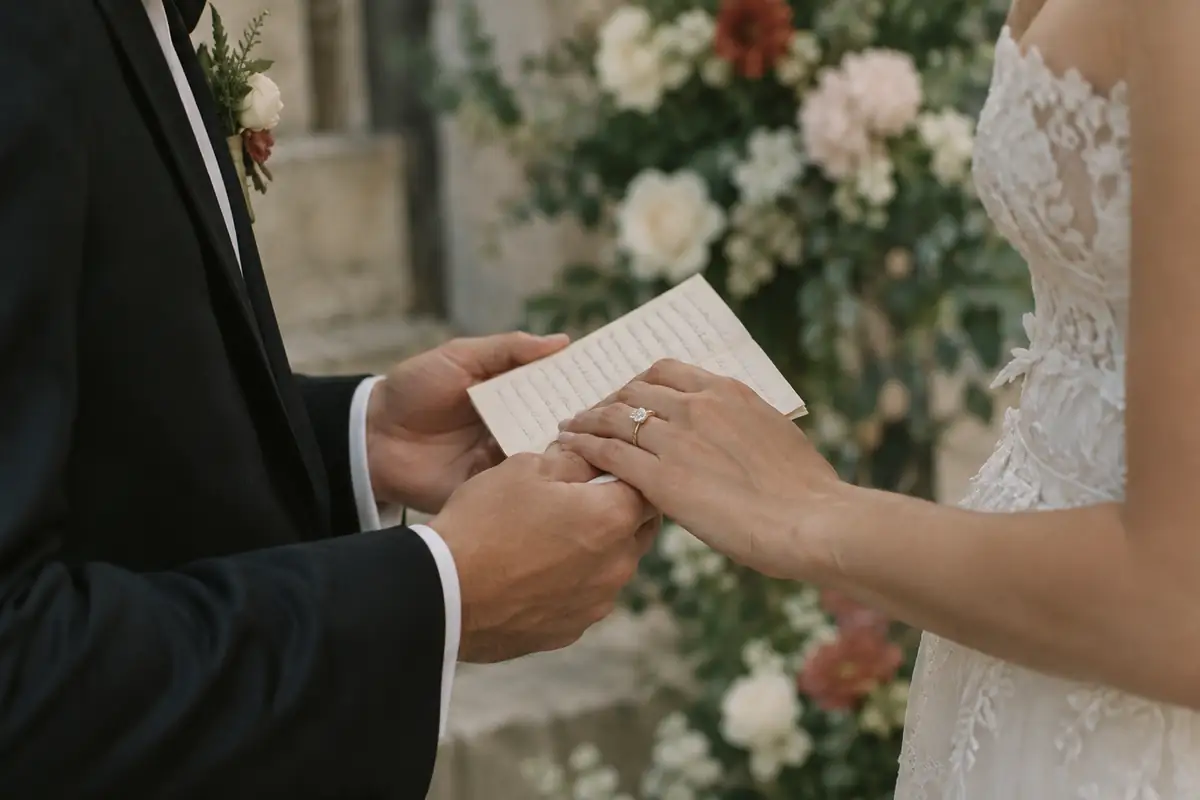
The Romans believed a vein ran directly from the fourth finger of the left hand to the heart, the vena amoris, or vein of love. Anatomy disagrees, but the idea stuck. In much of Europe — Germany, Russia, Spain, Norway and elsewhere — the wedding ring is traditionally worn on the right hand instead. Ring inscriptions has words for the inside of the band.
Many of these customs began as protection — against envy, bad luck or spirits — and survived as sentiment.
Bridesmaids
One of the older explanations is also the most practical: bridesmaids dressed like the bride so that any malevolent spirit — or jealous rival — could not tell which one she was. Whatever the truth of that, attendants have accompanied brides since antiquity. Choosing your wedding party covers the modern job.
The bouquet
Brides have carried flowers and herbs for thousands of years. Some were for luck, some for their meaning, and some — in the days before regular bathing — for their scent. Garlic and dill were once carried to ward off bad spirits; the Victorians made the bouquet a message, each flower chosen for its meaning in the language of flowers. Our flower meanings index is the complete Victorian dictionary.
Tossing the bouquet came later, and is said to have replaced a rowdier custom in which guests tore at the bride’s dress for a scrap of her luck. The woman who catches it will, supposedly, be the next to marry.
The cake
Roman weddings ended with a cake of wheat or barley broken over the bride’s head, a wish for fertility. Medieval English weddings had stacks of small spiced buns; the couple tried to kiss over the top without knocking them down. The tiered white cake came much later, and white icing, like the white dress, was a display of expensive refined sugar. Cutting the first slice together is the couple’s first shared task. Ordering the wedding cake covers the modern version.
Carrying the bride over the threshold
The explanations are many: to protect the bride from evil spirits lurking in the doorway, to avoid the bad omen of her tripping as she entered her new home, or as a relic of rather less romantic customs of marriage by capture. It survives because it is fun, and because the photographer likes it.
Keep what means something
None of these is an obligation. The rule most couples follow now is simply this: keep the customs that mean something to you or your families, and let the rest go without guilt. For customs beyond the English-speaking world, see wedding traditions around the world and our guide to Puerto Rican wedding traditions.
Written and edited by the Today’s Weddings editors. How we research and check what we publish is set out in our editorial standards. Spotted something wrong? Tell us.