When to Send the Invitations, and Everything Else
The complete stationery timetable — save-the-dates, invitations, reply cards and thank-you notes — and how to get them all into the post on time.
Wedding stationery runs on a timetable, and almost every stationery problem comes from starting a stage too late: invitations that go out five weeks before the wedding, replies that come back after the caterer’s deadline, a hundred envelopes addressed at midnight. Here is the whole sequence.
The timetable
| When | What |
|---|---|
| 6–8 months before | Save-the-dates, to everyone you are certain to invite |
| 4–6 months before | Order the invitations; allow time for proofs |
| 3 months before | Address the envelopes |
| 8–10 weeks before | Post the invitations (12 weeks for a destination wedding) |
| 4 weeks before | Reply deadline |
| 2–3 weeks before | Chase missing replies by phone; final numbers to the caterer |
| On the day | Programs, menus, place cards, escort cards |
| As gifts arrive, and within 3 months | Thank-you notes |
Save-the-dates
These are only necessary if guests need to plan ahead: travel, a holiday weekend, a destination wedding. They should go only to people you are certain to invite, because a save-the-date cannot be taken back. Keep them simple — names, date, place, and “invitation to follow.” If you have a wedding website, this is where to put its address.
The invitations
Order four to six months ahead. Letterpress and engraving take longer than digital printing, and you will want at least one round of proofs. Order at least ten percent more than you think you need, plus extra envelopes for mistakes.
Address them yourselves or have a calligrapher do it, and allow far longer than you expect: a hundred envelopes, done carefully, take a couple of evenings. Our guides to outer envelopes and inner envelopes cover the forms of address, and assembling invitations explains the order in which the cards go in.
Post them eight to ten weeks before the wedding, or twelve for a destination wedding, when guests need time to book flights. Any earlier and they get lost on the fridge; any later and people have made other plans.
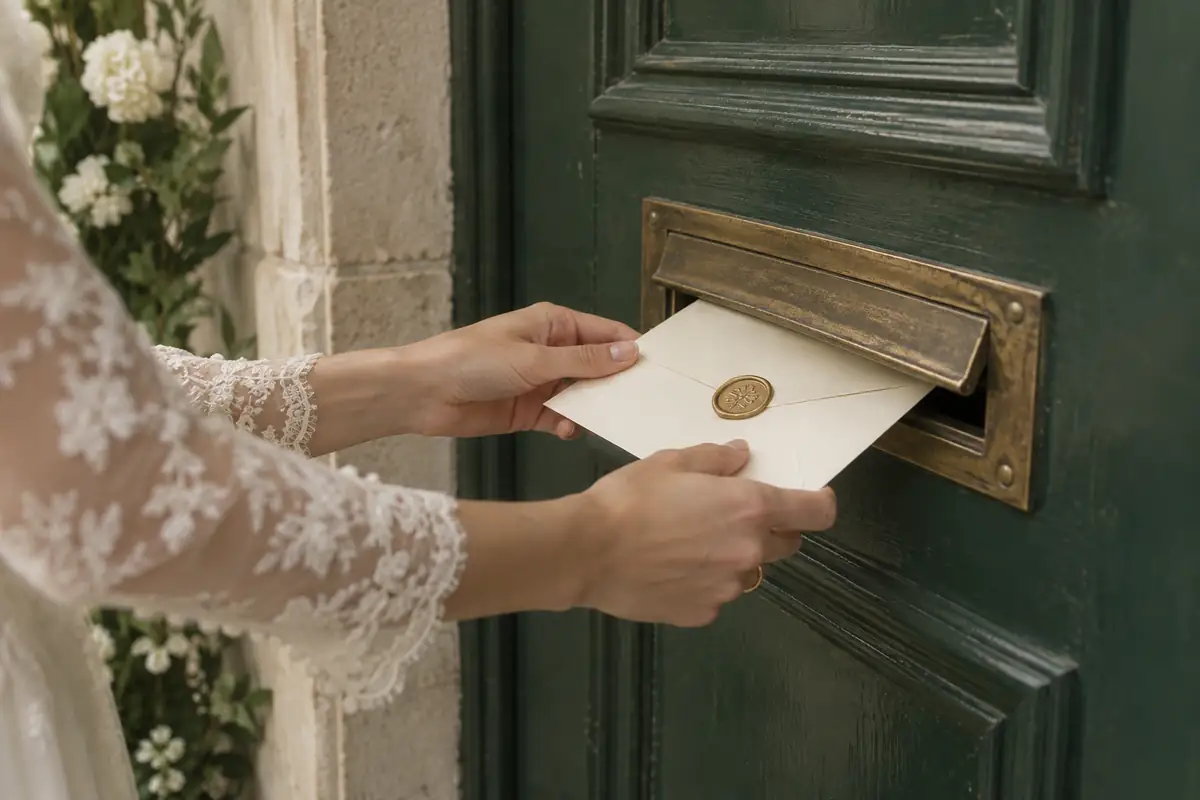
Weigh one first. Take a single, fully assembled invitation to the post office before you buy stamps. Square envelopes, heavy card, ribbons and wax seals often push the postage above the standard rate, and some need to be hand-cancelled. Guessing wrong means a stack of invitations returned to you, or arriving at your guests with postage due.
Take one assembled invitation to the post office and have it weighed. Guessing wrong means a hundred invitations coming back to you.
The reply date
Set it about four weeks before the wedding and at least two weeks before your caterer needs a final number. The last dozen replies always arrive late or not at all, and chasing them takes time. The day after the deadline, telephone everyone who hasn’t answered. It is not rude; it is expected, and most people are grateful for the reminder. For the guest’s side of the exchange, see how to RSVP.
Wording and who issues the invitation
The wording depends on who is hosting — your parents, one set of parents, the two of you, or everyone together — and gets more delicate when families are divorced, remarried or bereaved. Our invitation wording guide sets out the correct form for every situation, and invitation verses collects lines for the top of the card if you want one.
Stationery on the day
Programs, menus, escort cards and place cards are ordered with the invitations but finalized in the last two weeks, once you know who is coming. The guest list and the seating plan explains the difference between escort cards and place cards — and why getting it wrong stalls dinner service.
Announcements and thank-you notes
Announcements go out after the wedding to people who weren’t invited — colleagues, distant relatives, old friends — and carry no obligation to send a gift. Announcement wording has samples.
Thank-you notes should be handwritten and sent as gifts arrive, before and after the wedding. The traditional allowance of a year has done a great deal of harm by making people think they have one; aim for within three months of the wedding. Registry and gift etiquette explains how to write one that doesn’t read like a form.
Written and edited by the Today’s Weddings editors. How we research and check what we publish is set out in our editorial standards. Spotted something wrong? Tell us.