How to Write Your Own Vows
From a blank page to two minutes you can say out loud — what to include, what to leave out, and how to get through it standing up.
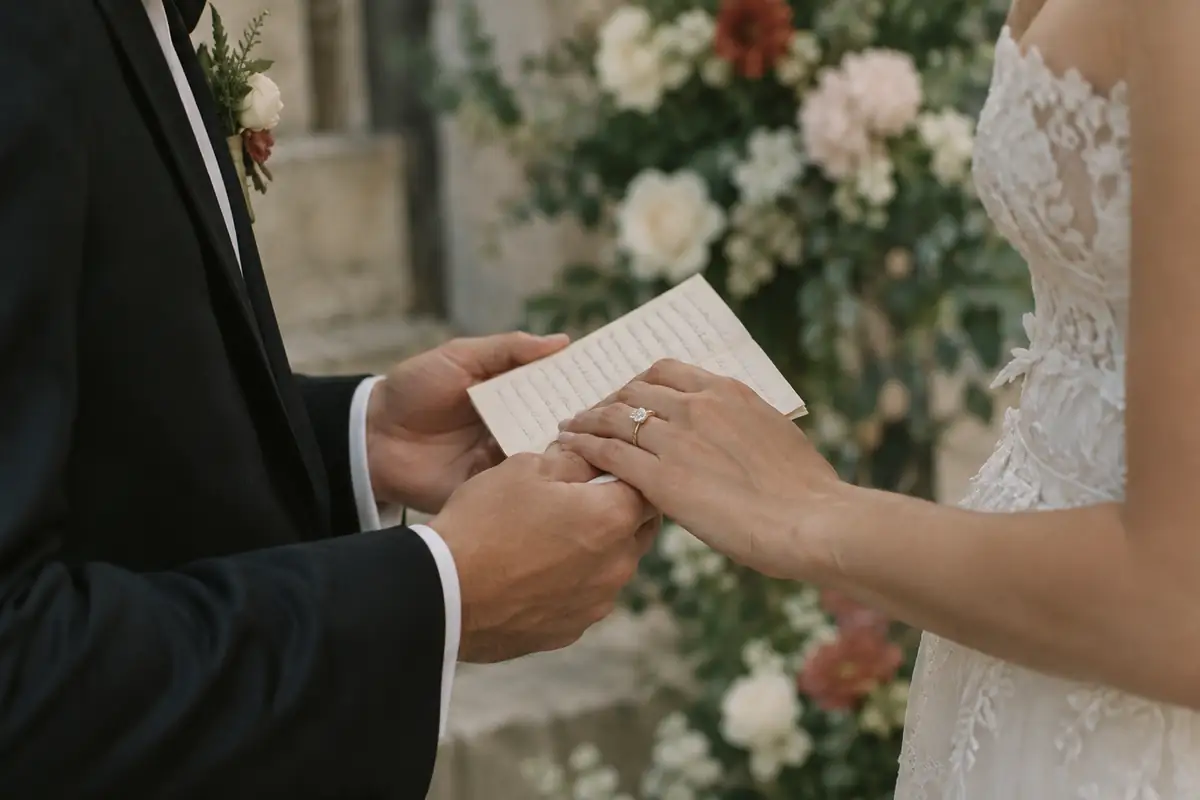
The traditional vows have lasted for centuries because they are nearly perfect. They are short, they are unambiguous, and they carry the weight of every couple who has said them before you. Nobody at your wedding will think less of you for using them. If you do decide to write your own, you are taking on something harder than it looks: a promise that has to be personal enough to mean something, universal enough that a room of a hundred people can follow it, and short enough to say while someone you love is holding your hands and looking straight at you.
It can be done. Here is how.
First, agree on the rules — together
Before either of you writes a word, sit down and decide three things.
Whether you are both writing your own. It is perfectly fine for one of you to write vows and the other to repeat the traditional words, but both of you should know in advance. Nobody wants to discover at the altar that the other person has written three paragraphs.
How long. Ninety seconds to two minutes each, which is roughly 150 to 250 words. That feels short on paper. Said slowly, in front of people, with your voice doing unexpected things, it is not short at all.
The tone. Solemn, warm, a little funny? You don’t need to match exactly, but a tender, tearful vow followed by a comic one is jarring for both of you and for the room.
Then tell your officiant. Some faiths require specific words for the marriage to be recognized, and some clergy will want to read what you have written. Find out now, not at the rehearsal.
What vows are actually for
A vow is a promise. That sounds obvious, but it is the thing most homemade vows forget. They become a love letter or, worse, a speech: how we met, the first time I saw you, the trip to Lisbon when it rained. None of that is a vow.
The strongest structure is simple:
- One or two sentences about who this person is to you. Not their résumé — what they are like to live beside.
- Your promises. Three to five, specific and concrete. This is the heart of it.
- A closing line that returns to the whole: all of this, for the rest of our lives.
The promises are where specific beats grand. I promise to love you forever is true, and everyone has heard it. I promise to make the coffee on the mornings you have to leave before it’s light is also true, and nobody in the room will forget it. The best vows mix both: one or two of the great, old promises — faithfulness, patience, choosing each other on the hard days — and one or two small ones that could only be about the two of you.
I promise to love you forever is true, and everyone has heard it. The small, specific promise is the one the room remembers.
Getting started when the page is blank
Don’t try to write the vows. Write around them first. Spend twenty minutes answering these, badly, in note form:
- What is something they do that nobody else notices?
- When did you know?
- What are you genuinely afraid of in marriage, and what would you promise to do about it?
- What does an ordinary Tuesday with them look like, and what would you promise about Tuesdays?
- What do you want to be true in thirty years?
Somewhere in those notes will be three or four sentences that sound like you. Build the vow around those, and throw the rest away.
If you want words from elsewhere to lean on, the ceremony readings are a good place to find a line to borrow and credit: a single sentence of Sonnet 116 or Elizabeth Barrett Browning as a closing line can carry a great deal. Just don’t borrow the whole poem — that’s what the readings are for.
What to leave out
Anything private. If you wouldn’t say it in front of your grandmother, your manager and your partner’s ex-roommate, it doesn’t belong in the vows. Save it for the letter you give them that morning.
Inside jokes. A single light moment is lovely. A reference only four people understand makes everyone else feel like a spectator.
Exes, past relationships, and anything that sounds like a comparison.
Other people. Vows are between the two of you. Children, if you have them, can have their own moment in the ceremony — many couples add a short promise to them after the main vows — but keep it separate.
Saying them
You will be more nervous than you expect, and nerves do two things: they make you speak fast, and they take away your breath. Plan for both.
Print them. Write or print the final version on a card — heavy stock, large type, no more than one side. Phones glow, lock themselves, and look terrible in photographs. Give the card to your officiant or a member of the wedding party to hold until the moment.
Mark the pauses. Put a line break after every sentence and actually stop at each one. What feels like an unbearable silence to you reads to the room as feeling.
Practice aloud, standing up. At least ten times, the last few in the clothes and shoes you will wear if you can. The first time you say the words should not be in front of a hundred people.
Look up. Glance at the card, then say the line to the person you are marrying. You are not reading to the guests; they are overhearing.
Let yourself cry. If your voice goes, stop, breathe, and carry on. It is the most human moment of the day, and nobody minds.
Where they go in the ceremony
Vows usually come after the readings and the address and before the exchange of rings. The order of the ceremony sets out the whole sequence. If you are writing your own, many couples still follow them with a short, traditional line — I take you to be my husband or my wife, for better, for worse — which gives the legally significant words their place and lets the room recognize the moment it has been waiting for.
Written and edited by the Today’s Weddings editors. How we research and check what we publish is set out in our editorial standards. Spotted something wrong? Tell us.