Modern Wedding Readings: Twenty-Five Couples Still Choose
Neruda, cummings, Angelou, Rilke, Wendell Berry and the anonymous favorites — what each piece says, how long it takes to read aloud, and where to find the full text.
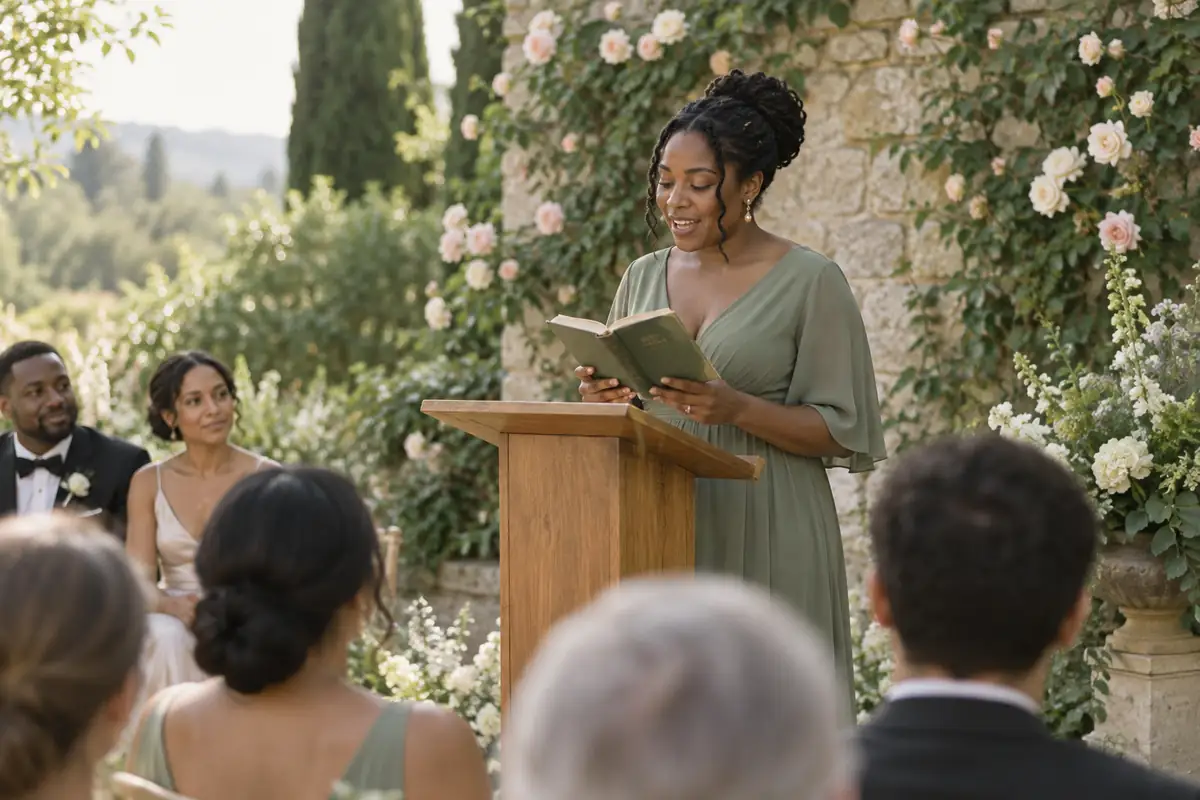
For many years Today’s Weddings printed the full text of the modern readings our readers asked for most. We have stopped doing that. The poems and passages below belong to their authors and publishers, and the right way to share them is to send you to the books. What we can do is tell you what each one says, why couples keep choosing it, how long it takes to read aloud, and where to find it.
For readings that are free to print in full — Shakespeare, the Brownings, Ruth, Corinthians and the rest — see our readings library. The order of the ceremony shows where readings usually fall.
Love poems
Sonnet XVII, Pablo Neruda
From One Hundred Love Sonnets (Cien sonetos de amor, 1959) · about 130 words · one minute
Neruda’s best-known love poem begins by refusing the usual comparisons — the rose, the topaz, the flame — and ends somewhere much more intimate: two people so close that the line between them disappears. It is quiet, sensual without being explicit, and reads beautifully aloud. Several English translations exist; Stephen Tapscott’s is the standard. For a bilingual wedding, one reader can take the Spanish and another the English.
Sonnet LXIX, Pablo Neruda
From One Hundred Love Sonnets (1959) · about 100 words · under a minute
The less familiar companion to Sonnet XVII, and in some ways the better wedding reading. It imagines the emptiness of a world without the beloved and closes on a gathering chain of I am, you are, we are — a line that lands with real force at the moment two people are about to become a household. Short enough to pair with something longer.
somewhere i have never travelled, E. E. Cummings
From W [ViVa] (1931) · about 160 words · just over a minute
The poem that ends with the rain’s small hands. Cummings’s lowercase and broken punctuation look daunting on the page, but the poem is gentle and tender aloud; the reader simply needs to practice where to breathe. Choose it if you want something romantic that doesn’t sound like a greeting card. It appears in every Cummings selection, including Complete Poems 1904–1962.
In Love Made Visible, May Swenson
About 110 words · under a minute
A poem about being seen: love as the thing that strips away the shells we keep between ourselves and the world. Swenson’s images are physical and surprising, and the last lines — two vessels pouring into each other — make a strong close. Less familiar to most guests than Neruda or Cummings, which is part of its appeal. It is collected in Nature: Poems Old and New.
Touched by an Angel, Maya Angelou
From Shaker, Why Don’t You Sing? (1983) · about 100 words · under a minute
Angelou’s short poem about the courage love demands: how it arrives, draws us out of our loneliness and asks everything of us, and how only love sets us free. It suits a couple who came to each other after difficulty, and its closing line is among the most quoted in American poetry. It is best read slowly by someone with a warm, unhurried voice.
Fidelity, D. H. Lawrence
1929 · about 100 words in the usual wedding excerpt · under a minute
Lawrence contrasts the flowers of passion, which come and go with the seasons, with the rock underneath them — the slow, hard jewel of trust that forms over years. Couples use the closing lines rather than the whole poem. It is an unsentimental choice for a couple who want to acknowledge that love changes and still endures.
’Til Death Do Us Part, Carol D. Bos
About 240 words · just under two minutes
A rhyming, openly religious poem that looks squarely at the vow’s final clause: not knowing what the years will bring, and promising love through all of it. It was one of the most requested pieces on the old site, particularly for church ceremonies and for couples marrying later in life.
Why Marriage? Mari Nichols-Haining
About 170 words · just over a minute
A list of reasons, each beginning because: to be known, to have a forever friend, to grow, to take half the responsibility for a shared life. It is modern, plain-spoken and popular with officiants for civil and interfaith ceremonies, and works well read by a close friend of both partners.
On marriage
The Art of Marriage, Wilferd A. Peterson
About 240 words · just under two minutes
A mid-century essay built as a string of short sentences — the little things are the big things; never going to sleep angry; not only marrying the right partner but being the right partner. It is the most-used non-religious reading in American ceremonies for good reason: guests nod along to every line. Some couples split it between two readers, alternating sentences.
A Marriage, Michael Blumenthal
From Against Romance (1987) · about 130 words · one minute
A single extended image: you are holding up a heavy ceiling alone, until someone walks in and holds it up beside you, and you take turns resting. It is one of the most moving short readings there is, and one of the few that talks about marriage as shared work rather than romance. It is a favorite of couples in their second marriage, and of anyone who has already been through something hard together.
Letters, Rainer Maria Rilke
Passages from Rilke’s letters, around 1901–1904 · about 400 words as usually assembled · three minutes
The wedding version is stitched together from several of Rilke’s letters, most famously the one describing a good marriage as two people who each stand guard over the other’s solitude. The German originals are long out of copyright; English translations may not be, so use a published translation such as those in Letters to a Young Poet and Rilke on Love and Other Difficulties. It is long — trim it to the passage about solitude for a two-minute reading.
Gift from the Sea, Anne Morrow Lindbergh
From Gift from the Sea (1955) · about 230 words · just under two minutes
Lindbergh’s meditation on love’s tides: we don’t love each other the same way every moment, and pretending otherwise is a kind of lie; security in a relationship lies in accepting its ebb and flow rather than clinging to it. It is wise, unsentimental and still widely read, and suits a reflective ceremony. The book is short and worth owning.
The Country of Marriage, Wendell Berry
From The Country of Marriage (1973) · about 90 words in the usual excerpt · under a minute
Berry, the Kentucky farmer-poet, describes marriage as a clearing in a forest — a house, an orchard, a garden — surrounded by a darkness that is richer than the light. The usual excerpt comes from the poem’s final section. It is ideal for a rural or outdoor wedding, or for a couple who value the long, slow work of making a home.
Tuesdays with Morrie, Mitch Albom
From Tuesdays with Morrie (1997) · about 170 words · just over a minute
Morrie Schwartz’s few rules about love and marriage — respect, compromise, talking openly, a shared set of values — delivered with the plainness of a man who knew he was dying. He ends by quoting a line he paraphrases from W. H. Auden: love each other or perish. Warm and conversational; guests who have read the book will recognize it at once.
The Bridge Across Forever, Richard Bach
From The Bridge Across Forever (1984) · about 130 words · one minute
Bach’s definition of a soulmate as someone whose keys fit our locks and whose locks fit our keys — the person with whom we can finally be entirely ourselves. It is romantic and a little mystical, and very much of its era. Good for a younger couple, or for anyone who read the book together.
A Natural History of Love, Diane Ackerman
From A Natural History of Love (1994) · about 120 words · one minute
Ackerman opens her book with a catalog of everything the small word love has done — altered history, calmed monsters, inspired art — and ends the passage with the heart as a living museum that keeps every moment of loving and being loved. It suits a couple who like their romance with a touch of science and wit.
Blessings
Blessing for a Marriage, James Dillet Freeman
About 250 words · two minutes
Freeman, a poet of the Unity movement, wrote this sequence of wishes — may you need one another, but not out of weakness; may you have happiness, and find it in making one another happy — and it has become one of the most-read blessings in American weddings. It is spiritual without belonging to any one faith, which makes it a natural choice for interfaith ceremonies, and a lovely thing for a parent or grandparent to read.
The “Apache” Wedding Blessing
About 200 words in its fullest version · one and a half minutes
Every wedding website calls this an Apache blessing. It isn’t. The words were written for the 1947 novel Blood Brother by Elliott Arnold and spoken in the 1950 Hollywood film adapted from it, Broken Arrow; they were later extended by others and passed around as traditional. Many couples still love it — now you will feel no rain, for each of you will be shelter to the other — and there is nothing wrong with reading it, but please don’t print it in your program as a Native American blessing. Credit it simply as “a wedding blessing,” or to Elliott Arnold.
I Ching
About 45 words · twenty seconds
A brief passage from the commentaries on the I Ching, the ancient Chinese book of changes: when two people are at one in their inmost hearts, they can break even iron, and their words are as fragrant as orchids. The source is ancient; the English most couples use is Richard Wilhelm’s translation as rendered by Cary F. Baynes (1950). It is short enough to open or close a ceremony, or to read alongside a longer piece.
The anonymous favorites
These pieces circulated for years on wedding forums, in officiants’ handouts and on sites like ours, usually without a reliable author. They are popular because they are simple and say exactly what they mean. If you use one, we’d suggest crediting it as “author unknown” rather than guessing, and we’d be glad to hear from anyone who can say who wrote them.
Marriage Joins Two People in the Circle of Its Love
Usually attributed to Edmund O’Neill · about 220 words · just under two minutes
A definition of marriage as a commitment to life, a physical and emotional joining promised for a lifetime, and a promise that takes a lifetime to fulfill. It reads like the sort of address an officiant might give, and some officiants use it that way.
Foundations of Marriage
Author unknown · about 220 words · just under two minutes
Love, trust and forgiveness as the three things a marriage stands on, with a frank acknowledgement that not every day will be exciting or romantic. Plain and heartfelt.
I Promise
Author unknown · about 150 words · one minute
Written as a sequence of promises — to give the best of myself, to respect you as your own person, to love you in good times and bad — and often used as the basis for personal vows rather than as a reading. See how to write your own vows.
My Love
Author unknown · about 130 words · one minute
A letter-like piece addressed directly to a partner: about not knowing how much life was about to change, and giving thanks for the miracle of the other. Better as a private note or a vow than as a reading by a third person.
A New Beginning
Author unknown · about 80 words · under a minute
A short, rhythmic poem about the oneness of all living things — each has a birth, a purpose, an end and a new beginning. It suits an outdoor or nature-centered ceremony.
Sound of Silence
Author unknown · about 70 words · thirty seconds
Not the Simon & Garfunkel song. A brief, philosophical poem about the space between two people as the place where meaning, music and the future are made. It is unusual and intellectual, and pairs well with something warmer.
Using a modern reading
Read it; don’t reprint it. Reading a poem aloud during your ceremony is how these pieces have always been shared. Printing the full text in your program, on a sign or on your wedding website is reproducing it, which the copyright holder may not allow. Put the title and author in the program instead — it’s more elegant anyway.
Buy the book. Most of these come from books still in print, and a copy makes a good gift to the reader, with the page marked. It also means your reader is working from a correct text rather than a version copied from website to website with errors multiplying along the way.
Mind the length. A comfortable reading pace is about 130 words a minute. Two readings of a minute or two each is plenty for most ceremonies.
Give the reader the text early — at least two weeks before — in large type, and ask them to practice aloud. The ceremony order guide shows where the readings usually fall.
Written and edited by the Today’s Weddings editors. How we research and check what we publish is set out in our editorial standards. Spotted something wrong? Tell us.