Wedding Dress Designers: A Guide to the Bridal Houses
Who makes the world’s wedding dresses, from Paris couture and Madison Avenue to the family-run labels stocked by independent salons, and what “couture” on a price tag really means.
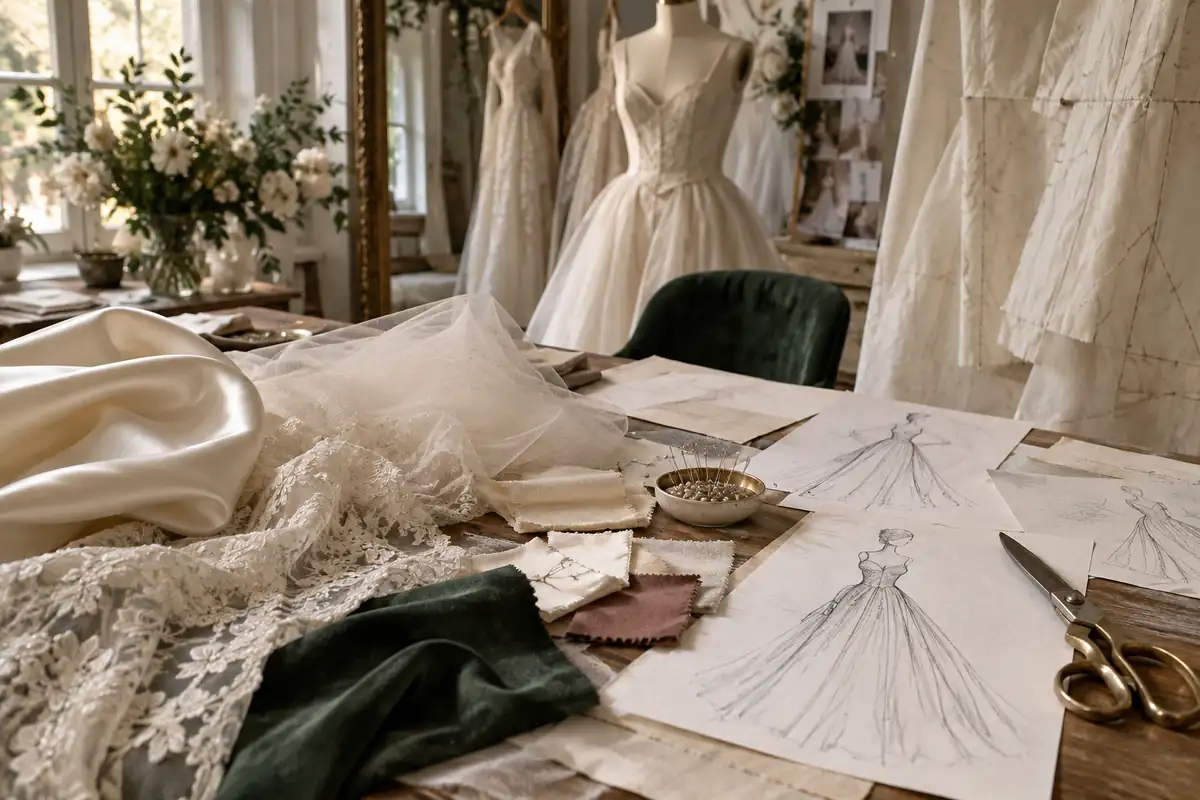
Vera Wang was forty and had spent seventeen years as an editor at Vogue and two at Ralph Lauren when she opened her bridal salon at the Carlyle Hotel on Madison Avenue in 1990. Monique Lhuillier started her label in 1996 because, planning her own wedding, she could not find a modern dress. Reem Acra designed her first wedding gown in three weeks, as a bet, for a friend. Many of the great bridal houses began the same way: with one woman’s frustration at what brides were being offered.
This guide introduces the names you will hear in bridal salons, explains the tiers they occupy, and sets out what the words on the price tag actually mean.
What “couture” really means
Haute couture is protected by law in France. To use the term, a house must be approved by the Fédération de la Haute Couture et de la Mode, and the criteria set in 1945 require made-to-order garments for private clients with one or more fittings, a Paris atelier with at least fifteen full-time staff and twenty full-time technical workers, and a collection of at least fifty original designs presented each January and July. Very few bridal designers meet that definition; a handful of Paris houses, among them Elie Saab and Viktor&Rolf, show haute couture and also make bridal.
In a bridal salon, the words are used more loosely:
- “Couture” or “designer” usually means a made-to-order gown with a high proportion of handwork and good fabric. It is a description of quality, not a legal status.
- Bespoke or custom means the pattern is drafted to your measurements and the design adapted for you, with several fittings. This is the closest most brides come to true couture.
- Made to measure means a standard pattern adjusted to your measurements before cutting.
- Made to order is the norm: you choose a sample, the shop orders it in the size closest to your measurements, and the factory or atelier makes it. It is then altered to fit. See our shopping guide for timings.
- Off the rack means you buy a dress in stock and take it home, as Priscilla Presley did in 1967.
Always ask a consultant which of these a dress is, where it is made, and what alterations are likely to cost.
How price tiers work
Price reflects fabric, handwork, where and how the dress is made, and the name on the label. According to The Knot’s 2026 Real Weddings Study, of more than 10,000 couples married in 2025, the average wedding dress cost about $2,100, with budget, middle and high tiers averaging roughly $1,200, $2,000 and $3,200. Around that center:
| Tier | Where you find it | What the price buys |
|---|---|---|
| Value | David’s Bridal, bridal outlets, sample sales | Ready-made and stocked styles; David’s Bridal emphasizes dresses under $1,000 and runs $99 sales |
| Mid-range designer | Independent salons stocking labels such as Justin Alexander, Maggie Sottero, Allure and Essense | Made-to-order gowns; Maggie Sottero lists its namesake line at about $1,500 to $3,300 |
| Luxury | Flagships and top salons (Kleinfeld, Saks, designer boutiques) | Finer fabrics, more handwork, smaller production |
| Couture and bespoke | Designer ateliers | Made for you, with multiple fittings |
For a sense of the top of the range, the dresses sold on Say Yes to the Dress, filmed at Kleinfeld in Manhattan, have ranged from about $1,300 to $40,000. What a wedding dress costs explains what drives the price, including the tariffs that raised costs across the industry in 2025.
The couture and luxury houses
Vera Wang. The house describes its founding mission as introducing fashion to bridal, and it did. Wang’s gowns, often in tulle and silk with unexpected drapery and color, have been worn by Victoria Beckham, Chelsea Clinton, Alicia Keys and Mariah Carey, and she has since opened bridal boutiques in London, Tokyo and Sydney.
Oscar de la Renta. Trained under Balenciaga and later designer of haute couture for Balmain, de la Renta dressed Jacqueline Kennedy and a series of first ladies. The house added bridal in 2006, and its gowns are known for romantic silk, embroidery and flowers. He died in 2014.
Carolina Herrera. Founded in New York in 1980 by the Venezuelan-born designer, who made Caroline Kennedy’s wedding dress. Wes Gordon has led the house since 2018, and its bridal line keeps the founder’s taste for crisp, ladylike structure.
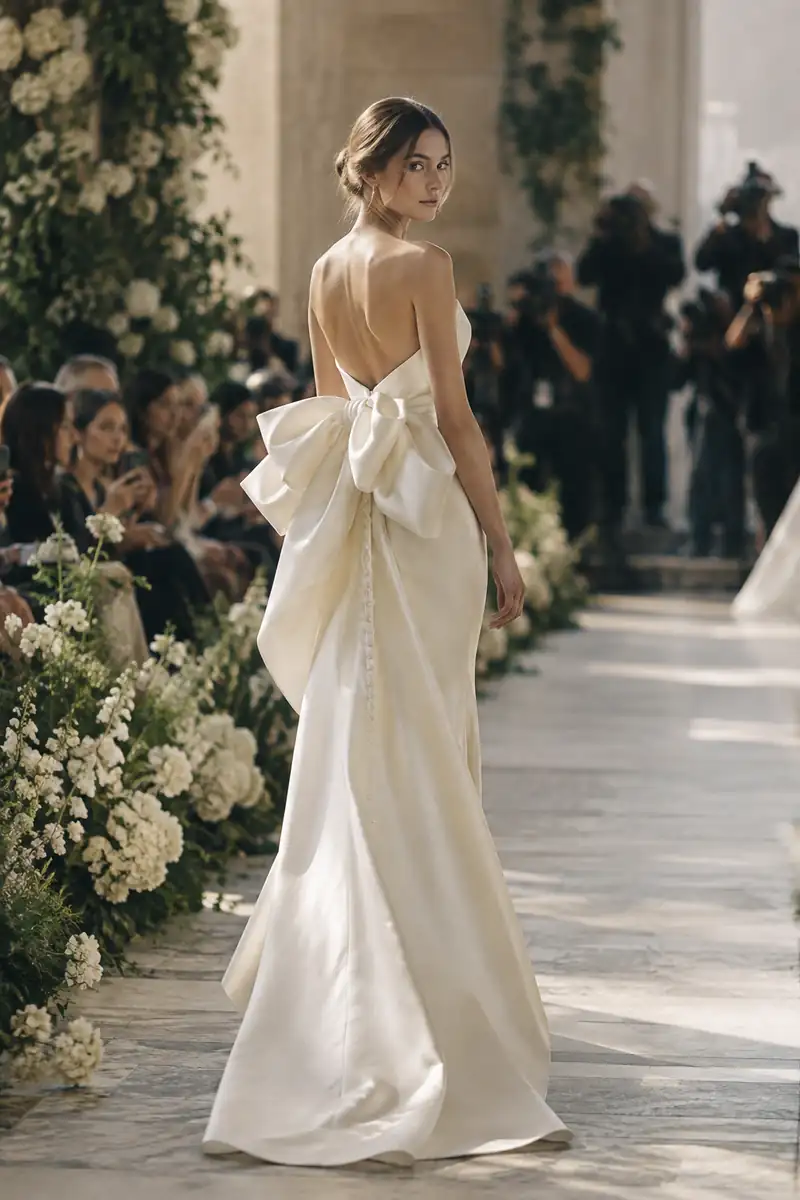
Monique Lhuillier. Launched in 1996 and based in Los Angeles, the label had its breakthrough in 2004, when Britney Spears wore Lhuillier for her wedding. Lhuillier was an anchor designer at New York Bridal Fashion Week in April 2026, where her plunging satin “Tribeca” dress was a highlight of the season’s minimalism.
Reem Acra. Born in Beirut, Acra founded her New York bridal label in 1997, and her first order, for thirty dresses, came from Saks Fifth Avenue and Kleinfeld. Her embroidered gowns are now sold by more than 150 retailers worldwide.
Elie Saab. Saab opened in Beirut in 1982 with fifteen employees, specializing in bridal couture. In 2003 he became the first Lebanese designer admitted to the Paris couture body, and the same year he began a bridal collaboration with Pronovias. He dressed Princess Stéphanie of Luxembourg for her 2012 civil wedding.
Zuhair Murad. The Beirut designer has been a regular at Paris Haute Couture Week since 2001. His embroidered, sheer-paneled evening style, all illusion tulle and crystal, carries directly into his bridal gowns.
Marchesa. Founded in 2004 by Georgina Chapman and Keren Craig, who met at Chelsea College of Art and Design, and named for the Marchesa Luisa Casati. Best known for romantic, heavily embellished red-carpet gowns.
Galia Lahav. A house of couture with four decades of history, offering couture, bespoke and ready-to-wear bridal lines and its own resale platform, RE:GALIA. In April 2026 it showed in New York with a collection partly inspired by Wuthering Heights.
Pronovias. Founded in Barcelona in 1922 by Alberto Palatchi as a shop selling lace, embroidery and fine textiles, Pronovias was one of the first companies in Spain to sell ready-to-wear wedding dresses. It now has more than 4,000 points of sale in over 100 countries and has been owned by Bain Capital and MV Credit since 2023.
Jenny Packham. The London designer first showed in 1988, and her bridal gowns share the beaded, softly glamorous style of her eveningwear. She has designed at least eight dresses for Catherine, Princess of Wales.
Temperley London. Founded in 2000 by Alice Temperley, with a bridal line since 2007: bohemian, lace-rich and English in feeling. Pippa Middleton wore a green Temperley gown to her sister’s wedding reception.
Danielle Frankel. A New York label made in the Garment District, with studios in New York and Los Angeles. It shows its numbered collections during New York Bridal Fashion Week; the April 2026 collection featured hand-cut silk organza and metal embroidery.
Markarian. At the April 2026 shows in New York, Markarian paired blazer-like tops and jackets with miniskirts and showed a softened basque waist.
Viktor&Rolf Mariage. Viktor Horsting and Rolf Snoeren founded their Amsterdam house in 1993 and are known for conceptual haute couture. Their bridal line, Viktor&Rolf Mariage, had its first runway show at Barcelona Bridal Fashion Week in April 2022 and now shows in New York.
Accessible and mid-range labels
The labels most brides actually wear are sold through independent salons. Many are family businesses, and their strength is fit: long experience of sizing, structure and what a bride needs to move, sit and dance.
Justin Alexander. Established in 1946, the company runs several lines, including Justin Alexander, Justin Alexander Signature (its designer label), Adore, Lillian West and Sincerity, and launched Poeza in 2026. In 2025 its chief executive told CNBC that about half its production was in China, 45 percent in Vietnam and 5 percent in Myanmar.
Maggie Sottero. The company behind three labels: Maggie Sottero, Sottero and Midgley, and Rebecca Ingram. It sells through a network of authorized boutiques and puts its emphasis on fit and flexible timelines.
Allure Bridals. Grew from a Tennessee family fabric store run by the Crum family into a design house by 2000, and is still family owned. Its brands include Allure Bridals, Allure Couture, Allure Romance, Madison James, Abella and Wilderly Bride. The company says its gowns are made over twelve to sixteen weeks in China and Myanmar.
Essense of Australia. Part of Essense Designs, alongside Martina Liana, Stella York, All Who Wander and Sorella Vita. Essense of Australia’s collections draw on the landscape of Western Australia and favor classic shapes with a twist.
David’s Bridal. The national chain sells many dresses under $1,000 through its stores and online, has opened an outlet shop-within-a-shop and runs $99 sales.
How to choose a designer
Start with the look, not the label. Decide on your style and silhouette, then find the designers who do it best. Salons know which of their labels cut well for different figures.
Ask where the dress is made, and how. A made-to-order gown from an overseas factory, a New York-made dress and a bespoke couture piece are different products with different timelines, and the difference is often not obvious on the rack.
Buy from authorized retailers. Designers list their authorized salons on their websites. Unauthorized copies of popular gowns are sold online, and a copy is only as good as its maker.
Use trunk shows. When a designer’s full collection visits a salon for a few days, you can try styles the shop does not usually stock, sometimes with a representative of the house present.
Remember the alternatives. Sample sales, secondhand and rental dresses and alternatives to the bridal salon can put a designer gown within reach. For the designers behind the most famous dresses of all, see celebrity wedding dresses and royal wedding dresses.
Written and edited by the Today’s Weddings editors. How we research and check what we publish is set out in our editorial standards. Spotted something wrong? Tell us.