Romantic Wedding Poems: Burns, Byron, Keats and Shelley
Eight poems from the Romantic age, from Burns’s red, red rose to Keats’s bright star: some of the most musical love poetry in English, and how to choose among it.
Several of the best love poems in English were first meant to be sung. Robert Burns shaped A Red, Red Rose from fragments of older Scots folk songs in the 1790s, and Thomas Moore set Believe Me, If All Those Endearing Young Charms to a traditional Irish air in 1808. That inheritance runs through this whole page. The poets of the Romantic generation, writing between the 1790s and the middle of the nineteenth century, wrote about love in plain words and strong rhythms, and their poems still sound right spoken aloud in a room full of people.
What they share is music and nature: roses and seas, fountains and rivers, a star, a sunflower. What separates them is mood and distance. Burns and Moore promise devotion directly. Wordsworth watches infatuation mature into partnership. Byron admires from across a room, Shelley argues with a wink, and Keats longs for constancy so intensely that his last line tips into rapture.
Choosing among them
For long love. John Anderson, My Jo is a wife speaking to her husband after many years: they have climbed the hill together and will go down it hand in hand. Burns rewrote it from an older, bawdier song, and his version is entirely tender. Read by grandparents, it is unforgettable. John Clare’s Love Lives suits the same kind of reader, and a rural wedding.
For friends who married. Wordsworth’s She Was a Phantom of Delight, written about his wife, Mary Hutchinson, traces love from first infatuation to settled partnership in three stanzas. At about eighty seconds it is the longest here.
For a light touch. Shelley’s Love’s Philosophy runs about forty seconds and makes a playful case that everything in nature comes in pairs.
Read the notes before you choose. Byron wrote She Walks in Beauty in 1814 after seeing his cousin by marriage at a party in mourning dress. It is a poem of admiration, not of marriage, so it belongs before the vows or as a family’s choice. Keats’s Bright Star, written around 1819 while he was in love with Fanny Brawne and published only after his death at twenty-five, ends with “swoon to death.” That is Romantic ecstasy, not gloom, but the reader should know it is coming and say it warmly.
Reading Scots and song lyrics aloud
Do not put on an accent you do not have. Burns’s Scots works in any voice if it is read slowly and without apology. Learn the handful of words that need it: in A Red, Red Rose, “gang dry” is go dry and “weel” is well; in John Anderson, jo is sweetheart, brent is smooth, beld is bald, pow is head and canty is cheerful. If your guests will not know them, print the glosses in the program.
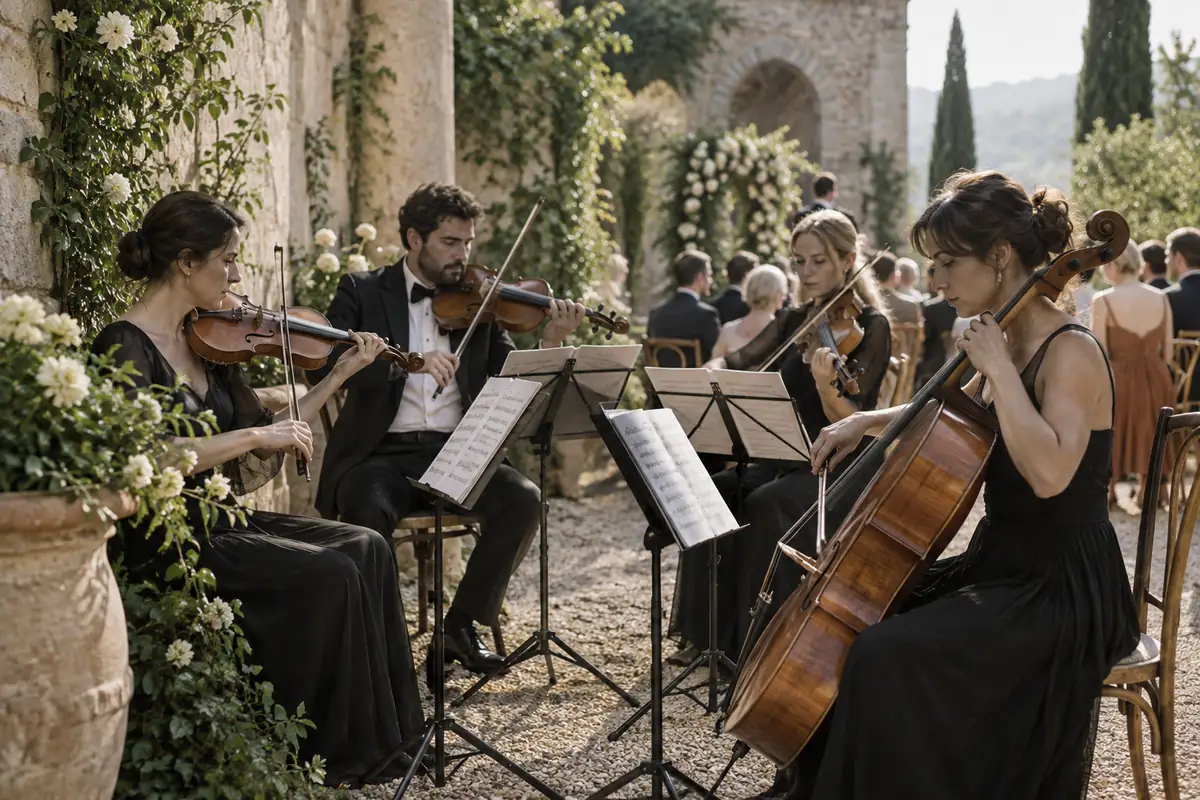
Song lyrics have strong, regular rhythms that tempt readers into a sing-song. Read for the sense of each sentence and let the rhyme take care of itself. Better still, if you have a singer, let them sing: Believe Me, If All Those Endearing Young Charms is set to the air that Harvard later borrowed for Fair Harvard, and it is lovelier sung than read. Our ceremony music guide has more ideas for that part of the day.
Pairings
Bright Star with Sonnet 116. Both make a fixed star the image of constant love; Shakespeare calls love “the star to every wandering bark.”
John Anderson, My Jo with Yeats’s When You Are Old. Two poems that look straight at old age and find love there: ideal for a vow renewal.
She Was a Phantom of Delight with No Woman Was Ever Nearer to Her Mate. Wordsworth’s portrait of a wife and Jane Eyre’s of a marriage, both arriving at companionship.
A Red, Red Rose
Robert Burns
O my Luve’s like a red, red rose
That’s newly sprung in June:
O my Luve’s like the melodie
That’s sweetly play’d in tune!
As fair art thou, my bonnie lass,
So deep in luve am I:
And I will luve thee still, my dear,
Till a’ the seas gang dry:
Till a’ the seas gang dry, my dear,
And the rocks melt wi’ the sun;
I will luve thee still, my dear,
While the sands o’ life shall run.
And fare thee weel, my only Luve,
And fare thee weel a while!
And I will come again, my Luve,
Tho’ it were ten thousand mile.
John Anderson, My Jo
Robert Burns
John Anderson, my jo, John,
When we were first acquent,
Your locks were like the raven,
Your bonnie brow was brent;
But now your brow is beld, John,
Your locks are like the snow;
But blessings on your frosty pow,
John Anderson, my jo!
John Anderson, my jo, John,
We clamb the hill thegither;
And monie a canty day, John,
We’ve had wi’ ane anither:
Now we maun totter down, John,
But hand in hand we’ll go,
And sleep thegither at the foot,
John Anderson, my jo.
She Was a Phantom of Delight
William Wordsworth
She was a Phantom of delight
When first she gleam’d upon my sight;
A lovely Apparition, sent
To be a moment’s ornament;
Her eyes as stars of Twilight fair;
Like Twilight’s, too, her dusky hair;
But all things else about her drawn
From May-time and the chearful Dawn;
A dancing Shape, an Image gay,
To haunt, to startle, and way-lay.
I saw her upon nearer view,
A Spirit, yet a Woman too!
Her household motions light and free,
And steps of virgin liberty;
A countenance in which did meet
Sweet records, promises as sweet;
A Creature not too bright or good
For human nature’s daily food;
For transient sorrows, simple wiles,
Praise, blame, love, kisses, tears, and smiles.
And now I see with eye serene
The very pulse of the machine;
A Being breathing thoughtful breath;
A Traveller betwixt life and death;
The reason firm, the temperate will,
Endurance, foresight, strength and skill;
A perfect Woman; nobly plann’d,
To warn, to comfort, and command;
And yet a Spirit still, and bright
With something of an angel light.
Believe Me, If All Those Endearing Young Charms
Thomas Moore
Believe me, if all those endearing young charms,
Which I gaze on so fondly to-day,
Were to change by to-morrow, and fleet in my arms,
Like fairy-gifts, fading away!
Thou wouldst still be ador’d, as this moment thou art,
Let thy loveliness fade as it will,
And, around the dear ruin, each wish of my heart
Would entwine itself verdantly still!
It is not, while beauty and youth are thine own,
And thy cheeks unprofan’d by a tear,
That the fervour and faith of a soul can be known,
To which time will but make thee more dear!
Oh! the heart that has truly lov’d, never forgets,
But as truly loves on to the close,
As the sun-flower turns on her god, when he sets,
The same look which she turn’d when he rose!
She Walks in Beauty
Lord Byron
She walks in beauty, like the night
Of cloudless climes and starry skies;
And all that’s best of dark and bright
Meet in her aspect and her eyes:
Thus mellow’d to that tender light
Which heaven to gaudy day denies.
One shade the more, one ray the less,
Had half impair’d the nameless grace
Which waves in every raven tress,
Or softly lightens o’er her face;
Where thoughts serenely sweet express
How pure, how dear their dwelling-place.
And on that cheek, and o’er that brow,
So soft, so calm, yet eloquent,
The smiles that win, the tints that glow,
But tell of days in goodness spent,
A mind at peace with all below,
A heart whose love is innocent!
Love's Philosophy
Percy Bysshe Shelley
The fountains mingle with the river,
And the rivers with the ocean;
The winds of heaven mix forever
With a sweet emotion;
Nothing in the world is single:
All things by a law divine
In another’s being mingle–
Why not I with thine?
See, the mountains kiss high heaven,
And the waves clasp one another;
No sister flower could be forgiven
If it disdained its brother;
And the sunlight clasps the earth,
And the moonbeams kiss the sea;–
What are all these kissings worth,
If thou kiss not me?
Bright Star
John Keats
Bright Star, would I were steadfast as thou art—
Not in lone splendour hung aloft the night,
And watching, with eternal lids apart,
Like Nature’s patient sleepless Eremite,
The moving waters at their priest-like task
Of pure ablution round earth’s human shores,
Or gazing on the new soft-fallen mask
Of snow upon the mountains and the moors—
No—yet still steadfast, still unchangeable,
Pillow’d upon my fair love’s ripening breast,
To feel for ever its soft fall and swell,
Awake for ever in a sweet unrest,
Still, still to hear her tender-taken breath,
And so live ever—or else swoon to death.
Love Lives
John Clare
Love lives beyond
The tomb, the earth, which fades like dew.
I love the fond,
The faithful, and the true
Love lives in sleep,
The happiness of healthy dreams
Eve’s dews may weep,
But love delightful seems.
‘Tis heard in Spring
When light and sunbeams, warm and kind,
On angels’ wing
Bring love and music to the mind.
And where is voice,
So young, so beautiful and sweet
As nature’s choice,
Where Spring and lovers meet?
Love lives beyond
The tomb, the earth, the flowers, and dew.
I love the fond,
The faithful, young and true.