How to Give a Wedding Toast
For the best man, the maid of honor and the father of the bride — how long to speak, what to say, what never to say, and how to land the ending.
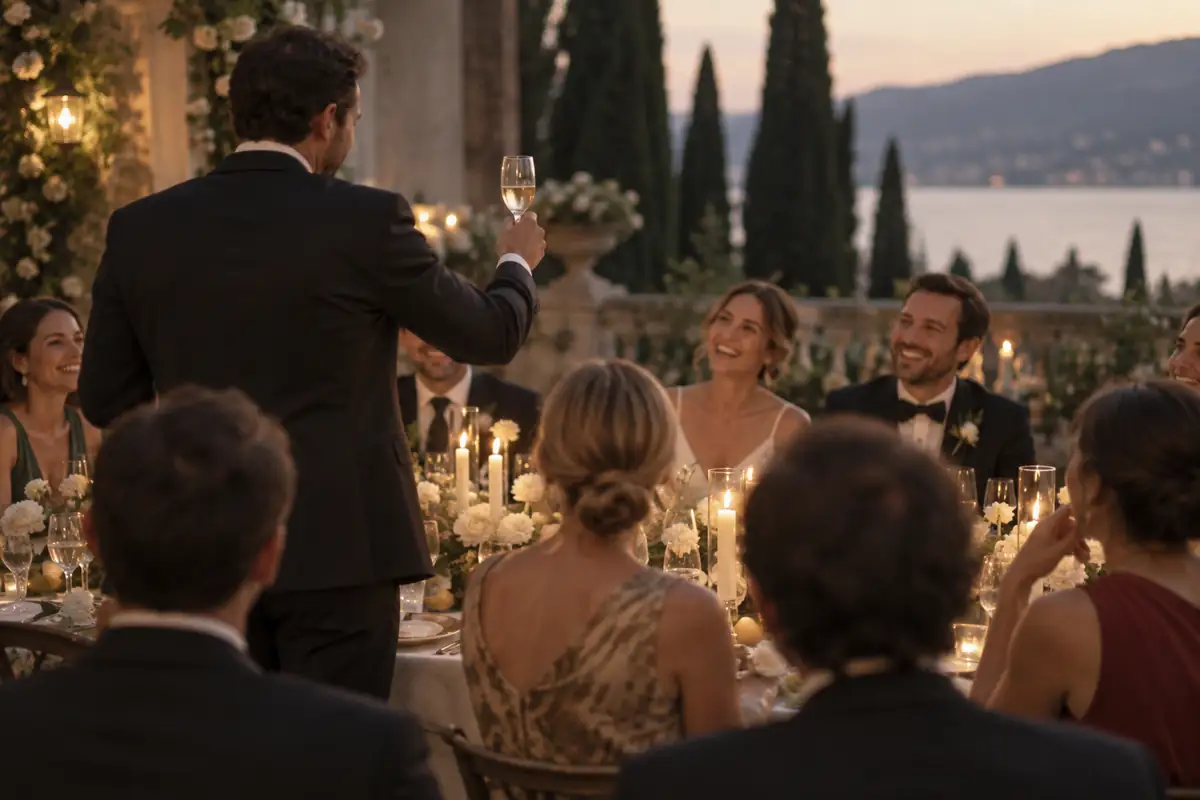
Nobody at a wedding wants a toast to be bad. The room is on your side before you stand up: everyone is warm, a little wine has been poured, and they have come precisely because they love the people you are about to talk about. The only way to lose them is to go on too long, to make it about yourself, or to say something the couple will have to explain to their grandparents. Avoid those three and you will be remembered fondly.
Who speaks, and when
At most weddings the toasts come in this order, usually between courses at dinner:
- The host, often the father or parents of the bride, who welcomes everyone and thanks them for coming.
- The maid or matron of honor.
- The best man, whose speech the room tends to wait for.
- The couple, briefly, to thank their families, the wedding party and the guests.
Many weddings now reorder or trim this, and three speakers is a sensible limit; see the reception, hour by hour for why. If you’re asked to speak, ask the couple exactly where you are in the running order and how long you have.
How long
Three to five minutes, which is about 400 to 650 words spoken at a comfortable pace. That feels short when you’re writing and endless when you’re standing. Time yourself out loud. If you go over five minutes in rehearsal, you will go over seven on the night, because nerves slow some people down and laughter adds time — which is a good problem, but plan for it.
A structure that works
Open with who you are. One sentence. For those who don’t know me, I’m Tom — I’ve been Sam’s friend since we were eleven, which means I’ve seen things. The joke is optional; the introduction isn’t.
Tell one story about the person you know. Not a highlights reel — one specific moment that shows their character. The time she drove four hours through snow to help you move. The way he still calls his grandmother every Sunday. A good story is specific, short, and makes a point you are about to make.
Turn to the couple. This is the pivot most toasts miss. You are not only there to talk about your friend; you’re there to talk about the two of them. When did you first see them together? What changed in your friend? What does the other person bring out in them?
Say something true about marriage — briefly. A line of your own, or one borrowed and credited. If you want a line of poetry, the ceremony readings are full of them.
Raise the glass. Ask everyone to stand, or to raise their glasses, and give the toast by name: To Sam and Priya. Then drink.
You are not only there to talk about your friend. You’re there to talk about the two of them — and the pivot is where most toasts go wrong.
What never to say
- Anything about exes. Not a joke, not a comparison, not a name.
- Anything about the bachelor or bachelorette party. What happened there stays there.
- Anything that needs explaining. If a quarter of the room won’t get it, cut it.
- Anything that would embarrass them in front of their grandparents or employer. A little teasing is part of the tradition. Humiliation is not.
- Anything about money, weight, religion or whether you expected this marriage to happen at all.
- Anything mainly about you. How long you’ve known them is context, not content.
On the night
Don’t drink much beforehand. One glass for nerves. The best man who is visibly drunk at the microphone is the only toast guests will remember for the wrong reasons.
Use notes. Cards in your hand are entirely acceptable and much safer than memory. Large type, one idea per card, numbered. Not your phone.
Hold the microphone properly — two or three inches from your mouth, pointed at it, all the time. Most toasts that can’t be heard are ruined by a microphone drifting down to chest height as the speaker gestures.
Pause for laughs. If they laugh, wait for it to finish before you speak again.
Look at the couple for the last line, then at the room for the raising of the glass.
If you’re the couple
Keep yours short — a minute or two. Thank your parents and anyone who paid for or worked on the wedding, the wedding party, and the guests who traveled. Then thank each other. That’s all anyone needs.
For the order of the whole evening, see the reception, hour by hour. For the rehearsal dinner, where a second round of more informal toasts often happens, see the archive’s guide to rehearsal dinners.
Written and edited by the Today’s Weddings editors. How we research and check what we publish is set out in our editorial standards. Spotted something wrong? Tell us.