Prince Charles and Lady Diana Spencer’s Wedding, 1981
St Paul’s Cathedral, 3,500 guests, a global audience of some 750 million and a 25-foot train. It was the wedding that defined 1980s bridal style.
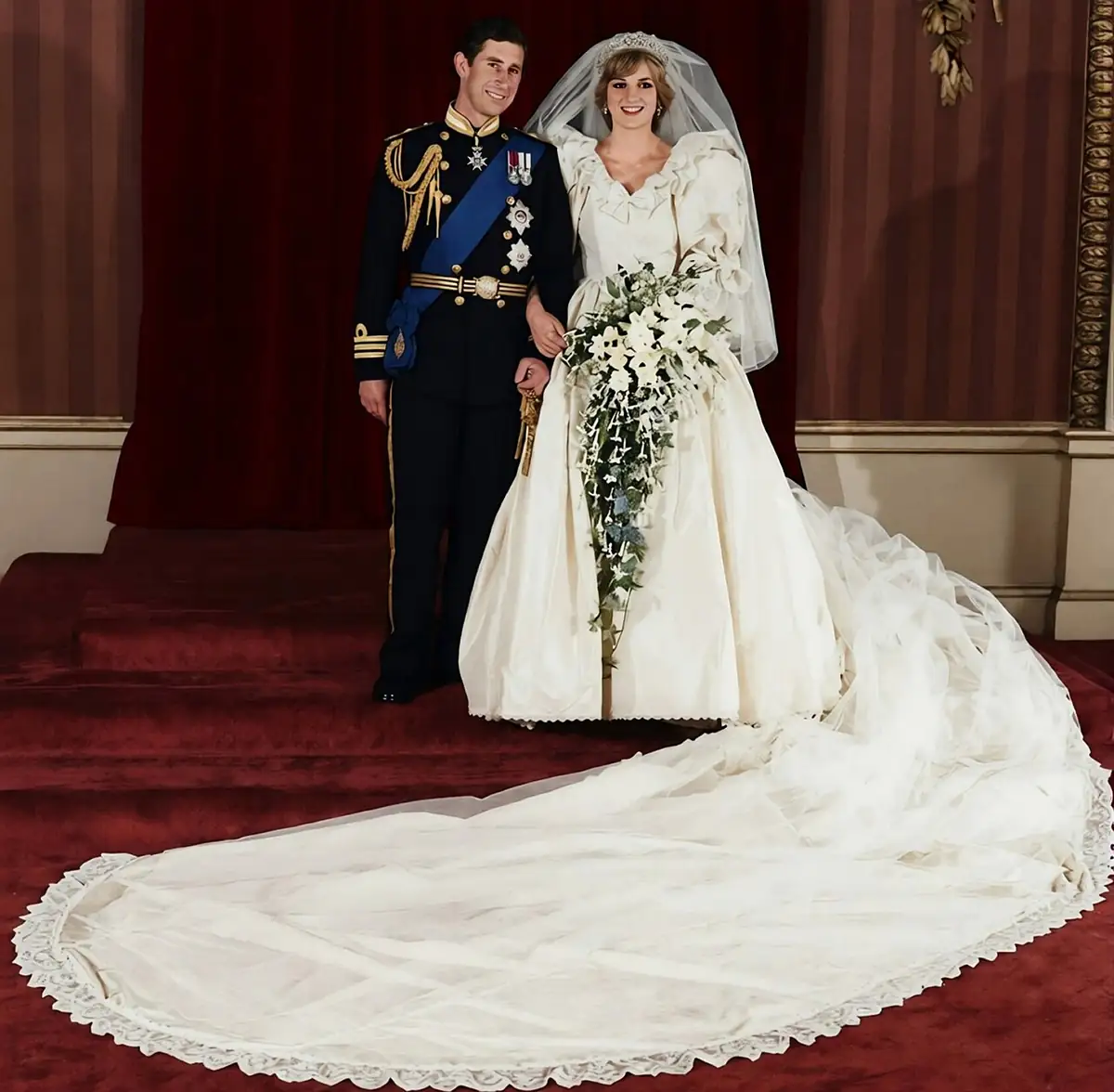
On the morning of July 29, 1981, Lady Diana Spencer stepped out of the Glass Coach at St Paul’s Cathedral with twenty-five feet of ivory silk taffeta and antique lace behind her, the longest train ever worn at a British royal wedding. She was twenty, the Prince of Wales was thirty-two, and around the world an estimated 750 million people were watching. Few weddings have so thoroughly set the look of bridal fashion for a decade.
| At a glance | |
|---|---|
| Date | Wednesday, July 29, 1981 |
| Place (ceremony) | St Paul’s Cathedral, London |
| Reception | Wedding breakfast for 120 guests at Buckingham Palace |
| The dress (designer) | David and Elizabeth Emanuel |
| Guests | 3,500 at the cathedral |
| Officiant | Robert Runcie, Archbishop of Canterbury |
The couple
The engagement was announced on February 24, 1981. Lady Diana’s ring, a 12-carat oval Ceylon sapphire surrounded by fourteen diamonds and set in white gold, would later be given by her son to Catherine Middleton.
The couple had two sons, Prince William and Prince Harry. They separated in 1992 and divorced in 1996. Diana, Princess of Wales, died in a car crash in Paris in August 1997. Charles, who married Camilla Parker Bowles in 2005, became King in September 2022.
The ceremony
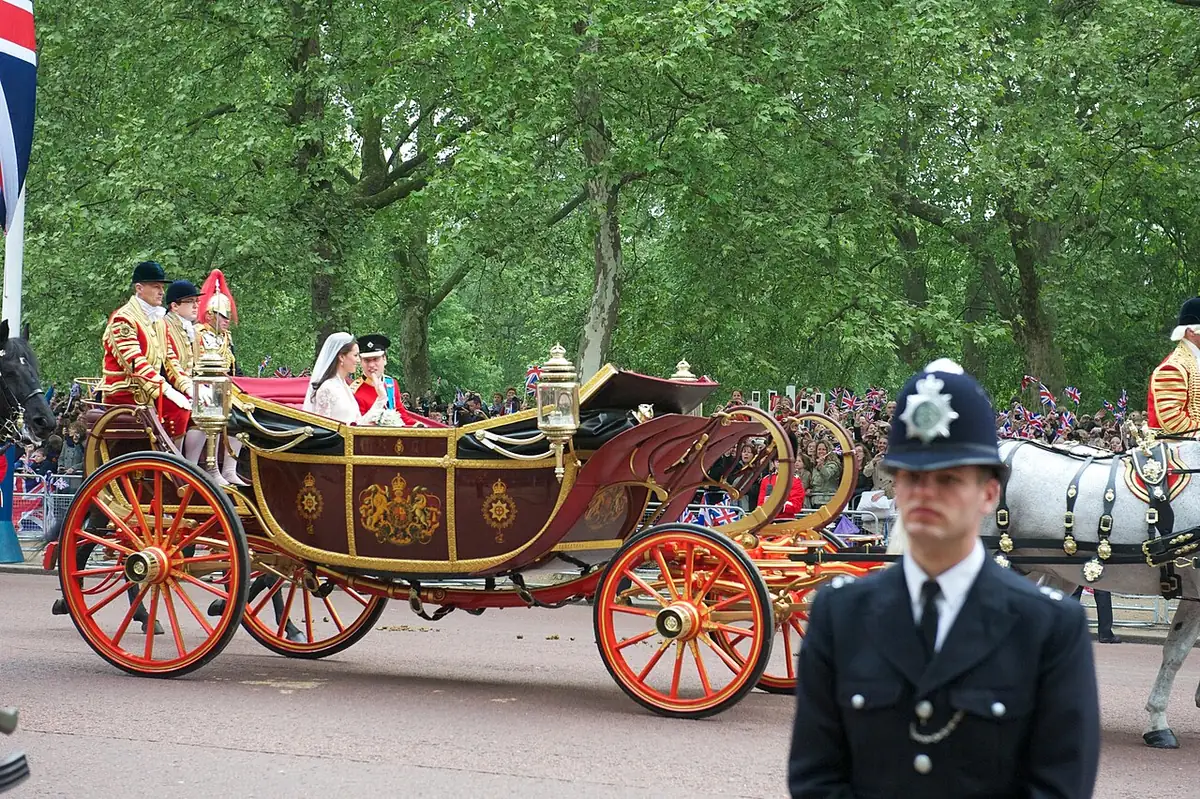
The couple chose St Paul’s rather than Westminster Abbey because it offered more seating and a longer procession through London; some two million people lined the route. The day was a national holiday in Britain, and 28.4 million people watched in the United Kingdom alone.
Diana arrived in the Glass Coach with her father, Earl Spencer, and walked up the aisle to Jeremiah Clarke’s “Prince of Denmark’s March.” The Archbishop of Canterbury, Robert Runcie, married them, with the Dean of St Paul’s, Alan Webster. The New Zealand soprano Kiri Te Kanawa sang Handel’s “Let the Bright Seraphim.”
Two moments from the vows are still remembered. Diana did not promise to “obey” her husband; the word had been removed at the couple’s request, which caused a sensation at the time. And she reversed the order of the Prince’s names, calling him “Philip Charles Arthur George.”
The dress
David and Elizabeth Emanuel made the dress in conditions of great secrecy: they kept heavy blinds on the windows and locked the sketches in a safe. It was ivory silk taffeta, with a fitted, boned bodice, a full crinolined skirt and large puffed sleeves finished with lace flounces. The bodice was paneled with antique Carrickmacross lace, part of it from Queen Mary’s collection, which had been given to the Royal School of Needlework, and the dress was embroidered with thousands of sequins, including mother-of-pearl ones, and some 10,000 pearls.
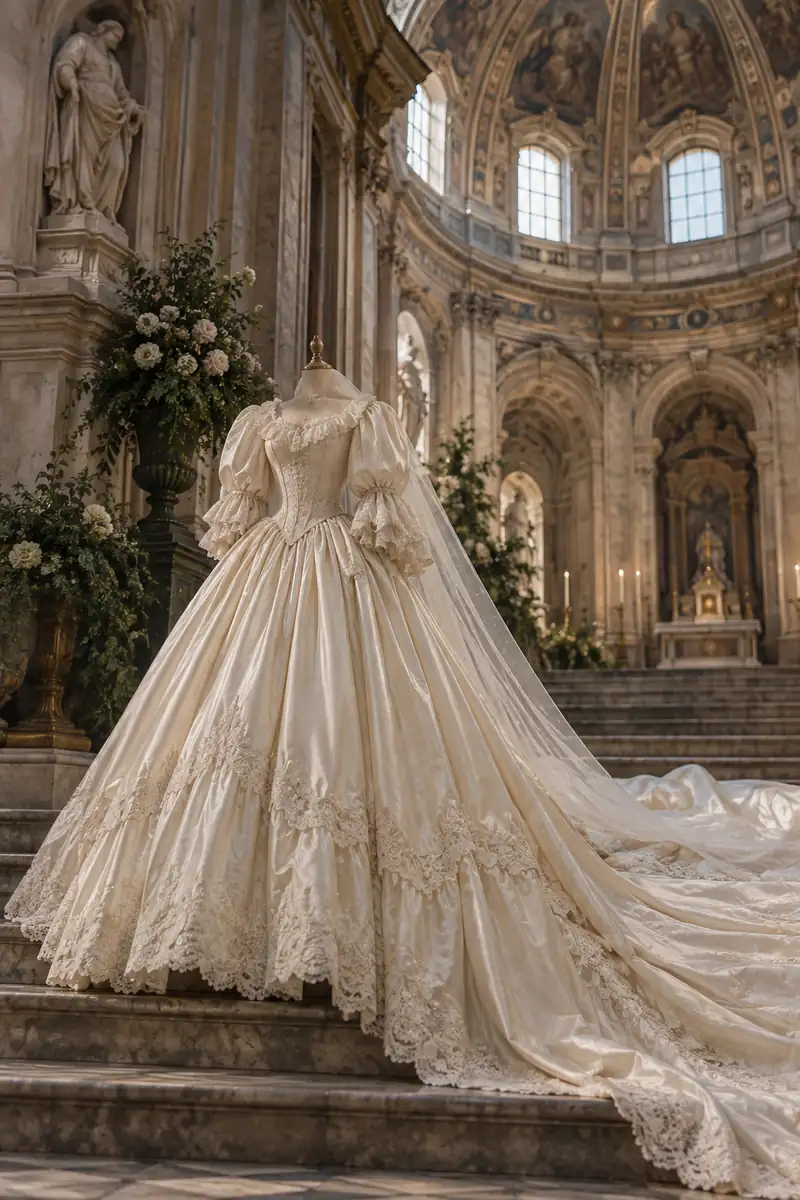
The ivory silk tulle veil, scattered with mother-of-pearl sequins, was held by the Spencer family’s diamond tiara. She also wore her mother’s earrings. Her slippers, by Clive Shilton, were decorated with 542 sequins and 132 pearls.
The florist David Longman made two identical bouquets, on the Queen’s instructions. They held gardenias, stephanotis, odontoglossum orchids, lily of the valley, Earl Mountbatten roses, freesias, veronica, ivy and myrtle.
The dress was shown at Kensington Palace in 2021 in the exhibition Royal Style in the Making. For how it compares with other royal gowns, see our guide to royal wedding dresses.
The reception
After the service the couple rode back to Buckingham Palace and appeared on the balcony, where, to the delight of the crowd, they kissed. It was the first balcony kiss, and it began a tradition later royal couples have followed. The wedding breakfast inside was for 120 guests.
The couple received 27 wedding cakes. The official one, made by David Avery, took fourteen weeks to complete. They began their honeymoon at Broadlands in Hampshire, where the Queen and Prince Philip had spent their wedding night in 1947, and then cruised the Mediterranean aboard the Royal Yacht Britannia.
Why it mattered
Its influence on ordinary weddings was immediate. Copies of the dress were on sale within hours, and the pattern companies McCall’s and Burda rushed out sewing patterns. For the rest of the 1980s, brides wore puffed sleeves, fitted waists, ruffles, full tulle-filled skirts and long trains. The scale of the day, the cathedral, the carriages and the television audience also changed what people expected a royal wedding to be. William and Catherine’s wedding in 2011 returned to Westminster Abbey and a far simpler dress, and part of the pleasure lay in the contrast. For the pattern it followed, see the 1947 wedding of Princess Elizabeth, and for the full sweep, The Great Royal Weddings.
Borrow the idea
Have a spare bouquet. The duplicate bouquet is a sensible idea for any wedding with a long day of photographs. Ask your florist for a small duplicate, or a separate bouquet for tossing. Our wedding-day flowers checklist will help.
Plan the train. If you choose a long train, decide in advance who will arrange it at the church door and at the altar, and practice at the rehearsal. A detachable train or bustle makes the reception easier.
Rewrite the vows you don’t mean. Diana showed that traditional words can be adjusted. Talk to your officiant early; our guide to writing your wedding vows covers what can and cannot change.
Take the sleeves, not the whole look. A soft puffed or flounced sleeve on a simple modern dress nods to 1981 without dating the photographs.
Written and edited by the Today’s Weddings editors. How we research and check what we publish is set out in our editorial standards. Spotted something wrong? Tell us.